CVD vs HPHT Lab-Grown Diamonds: Which Method Is Better?
The two methods used to grow lab diamonds explained in full. Growth conditions, quality differences, and what the production method means for your purchase.
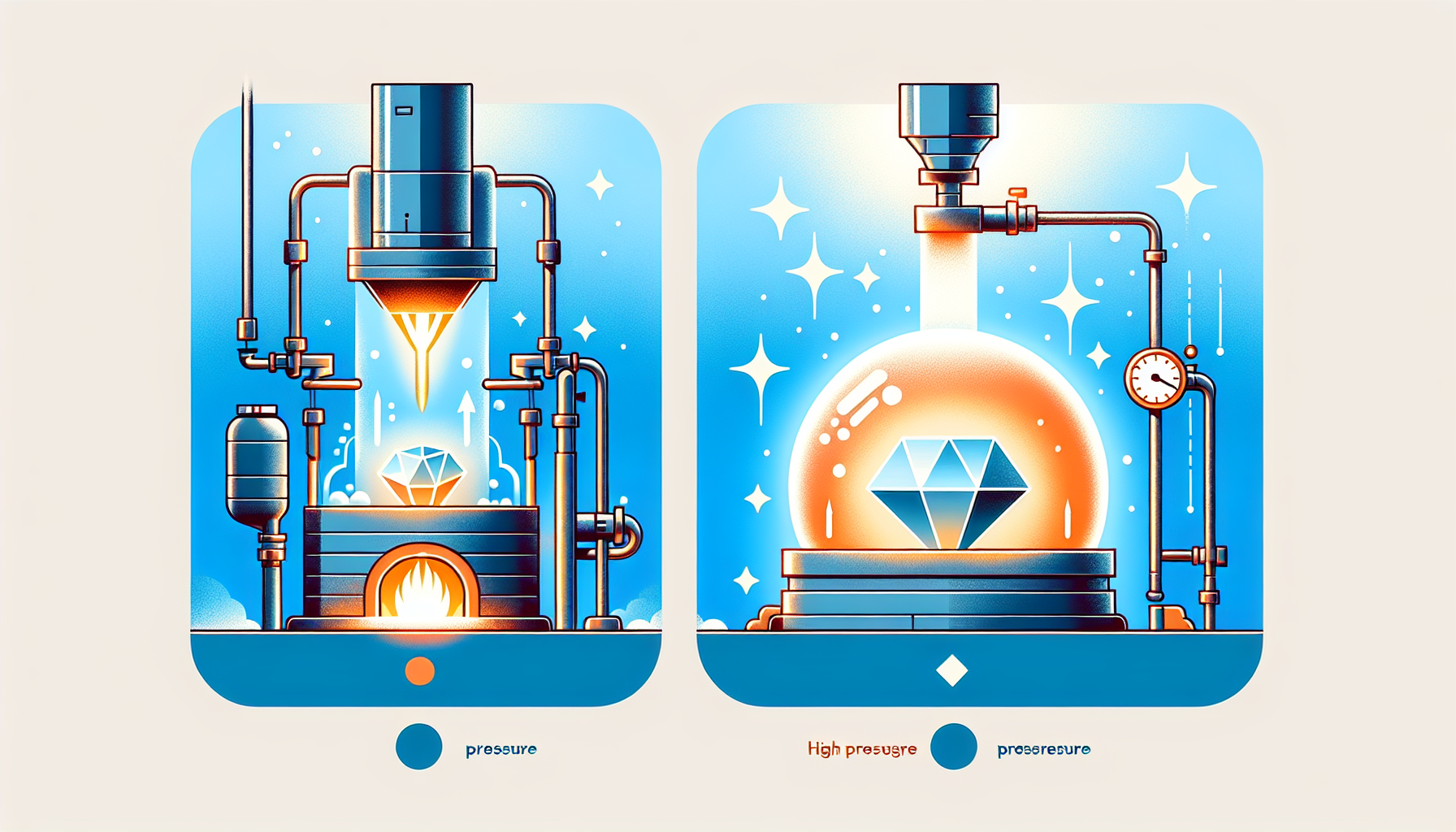
CVD: Chemical Vapour Deposition
A diamond seed crystal is placed in a vacuum chamber. Carbon-rich gas (typically methane) is introduced and energised using microwave power or lasers. The carbon atoms break free and deposit onto the seed crystal layer by layer, growing a diamond over 2-4 weeks.
Temperature: approximately 1,500 degrees Fahrenheit. Pressure: near-atmospheric (no extreme pressure required). The diamond grows in a single direction (cubic), which tends to produce more even colour distribution.
- Tends to produce higher clarity grades
- More even colour distribution
- Can show strain lines under UV (not visible to naked eye)
- Now the dominant production method globally
- Lower energy consumption than HPHT
HPHT: High Pressure High Temperature
HPHT replicates the natural conditions under which diamonds form inside the earth. A diamond seed, carbon source, and metal catalyst (typically iron or nickel) are subjected to pressures of 1.5 million PSI and temperatures above 2,000 degrees Fahrenheit.
The diamond grows in 14 directions simultaneously (cuboctahedron shape). Growth time: 2-4 weeks for gem-quality stones. HPHT was the first commercial method and has a longer track record.
- Can develop yellowish tints from nitrogen exposure
- May show metallic inclusions from catalyst
- Cross-shaped fluorescence pattern under UV
- Also used as post-growth treatment to improve colour
- Higher energy consumption than CVD
Side-by-Side Comparison
| Property | CVD | HPHT |
|---|---|---|
| Growth temperature | ~1,500 F (815 C) | ~2,200 F (1,200 C) |
| Growth pressure | Near atmospheric | ~1.5 million PSI |
| Growth direction | Single (cubic) | 14 directions (cuboctahedron) |
| Growth time (1ct) | 2-4 weeks | 2-4 weeks |
| Typical colour tendency | Near-colourless | May show N-O range tint |
| Typical clarity | IF to VS (often higher) | VS to SI (more variable) |
| Common inclusions | Strain lines, pinpoints | Metallic inclusions |
| UV fluorescence | Variable, parallel lines | Cross-shaped pattern |
| Energy consumption | Lower | Higher |
| Market share (approx) | ~70% of production | ~30% of production |
| Post-growth treatment | Occasional | Common (colour improvement) |
Which Should You Choose?
For most buyers: the production method matters far less than the 4C grades on the certificate.
If you buy an Excellent-cut, F-colour, VS1-clarity diamond with a GIA or IGI certificate, that stone will be beautiful regardless of whether it was grown by CVD or HPHT. The grade on the certificate is what matters. Focus on finding a well-graded, well-priced stone from a reputable retailer with a solid return policy.
If you want to know the production method: check the certificate. GIA and IGI both state whether a stone is CVD or HPHT on the grading report. Some retailers also disclose this in the product listing.
If your priority is highest clarity and most even colour: CVD has a slight edge statistically. If you are buying from a retailer that discloses method and the CVD stone grades higher for similar price, prefer CVD. But do not reject an excellent HPHT stone with great grades just because of the method.