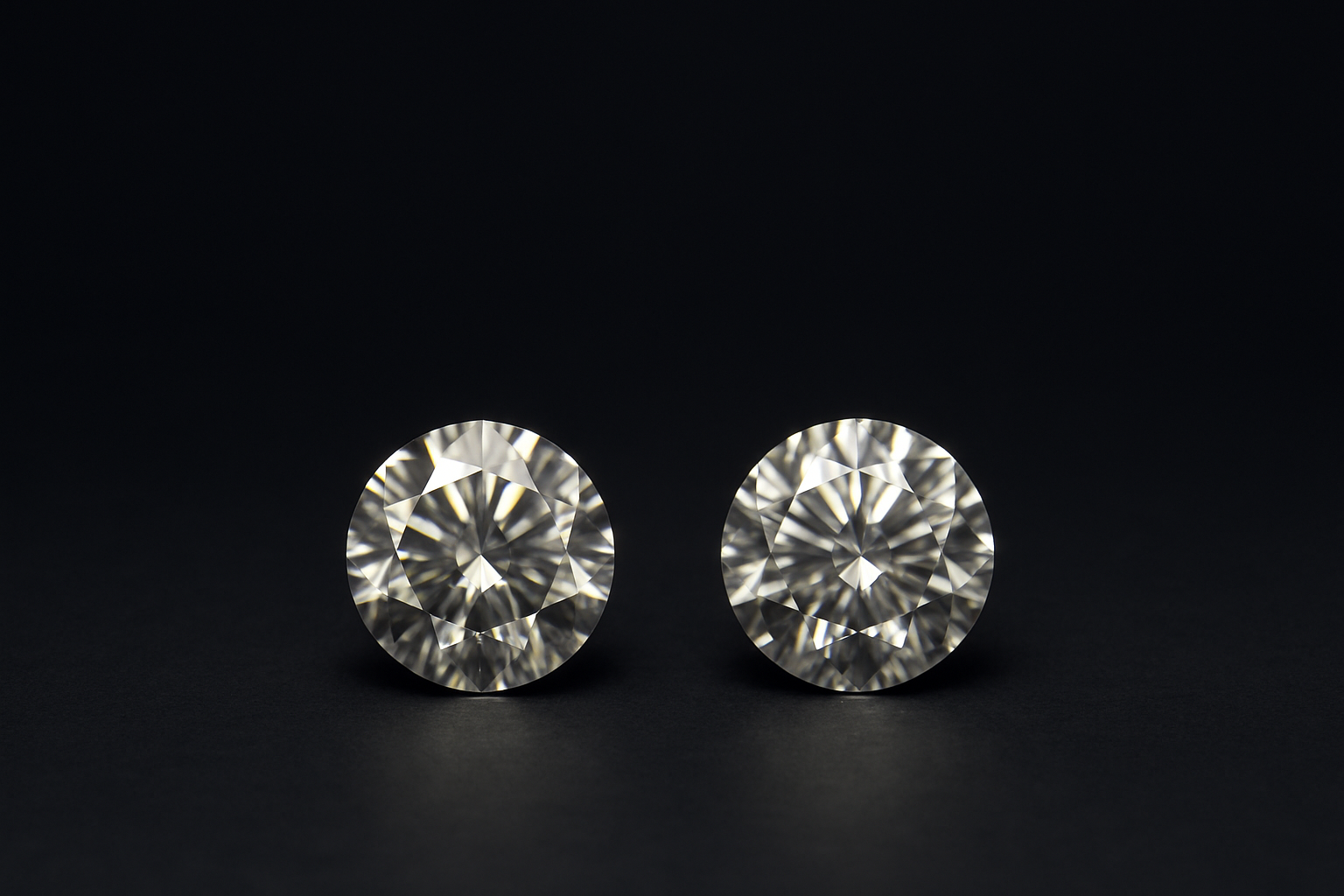
Three dimensions, no verdict
| Dimension | Lab-Grown | Natural | Source |
|---|---|---|---|
| Chemistry | Pure carbon, sp3 cubic lattice, refractive index 2.42 | Pure carbon, sp3 cubic lattice, refractive index 2.42 | 1, 3 |
| GIA grading (since Oct 2025) | Premium / Standard / not reported below Standard | Cut, Colour D to Z, Clarity FL to I3, Carat | 2 |
| Price (Bain 2021-22) | Polished retail ~30%, wholesale ~14% of natural | Reference / market average | 4 |
| Public price anchor | De Beers Lightbox: $800/ct (2018), $500/ct (2024), closed (2025) | Antwerp rough: $99 to $72/ct in Q1 2026 (-27% YoY) | 5, 6 |
| Carbon (per carat) | 15-50 kg CO2e on renewables, 200-480 kg on coal grids | Roughly 125-160 kg CO2e cradle-to-gate | Ch 11 |
| Conflict-diamond scope | Bypasses Kimberley Process (covers rough mining only) | Covered by KP rough certification, with documented gaps | Ch 10 |
Each row points to a named public source. We do not declare a winner because the trade-offs are real and depend on what the reader values. See Chapter 12 for the structured comparison.
Fourteen chapters, one appendix, one editorial note
How Diamonds Are Made
Mantle crystallisation, HPHT synthesis, and CVD deposition compared. The three pathways from carbon to crystal.
Chapter 02CVD vs HPHT
Apparatus geometry, growth-front chemistry, crystal types, and inclusion character of the two laboratory methods.
Chapter 03The 4Cs Explained
Cut, colour D to Z, clarity FL to I3, and carat weight. The grading system GIA invented in the 1940s.
Chapter 04GIA vs IGI
Two grading laboratories. GIA founded 1931, IGI founded 1975. How they differ on methodology and market share.
Chapter 05GIA Lab-Grown Grading Change
October 2025: GIA moved lab-grown diamonds off the D-Z and FL-I3 scales onto a new Premium / Standard tier system.
Chapter 06FTC Diamond Rules
What can legally be called a diamond in US commerce. The 2018 Jewelry Guides revision and required disclosures.
Chapter 07Price Structure
Why lab-grown polished trades at a fraction of natural. Production economics, supply elasticity, and cost-plus floors.
Chapter 08Price History (2016 to 2026)
The publicly citeable timeline. Lightbox 2018 launch, 2024 cut, 2025 closure. Wholesale decline of roughly ninety per cent.
Chapter 09Market Data
AWDC 2025 trade figures, Q1 2026 rough-price decline, Bain ratios, and the definition problem with market-share numbers.
Chapter 10The Kimberley Process
What the conflict-diamond scheme actually covers, what it does not, and why civil-society groups consider it inadequate.
Chapter 11Environmental Impact
Cradle-to-gate kWh and kg CO2e per carat for both categories. Why the answer depends on the electricity grid.
Chapter 12Ethics Framing
Three independent variables: labour, environment, provenance. A structured trade-off table without a verdict.
Chapter 13Telling Them Apart
Why the naked eye cannot distinguish them, why standard diamond testers cannot either, and what laboratory equipment does.
Chapter 14Resale and Value
What both categories recover at resale, why neither is an investment, and how cost-plus pricing affects lab-grown buybacks.
Actual size by carat weight
Round brilliant face-up diameter at each carat. The relationship is identical for lab-grown and natural; carat weight is mass, and the density of pure carbon is the same.
The chart above is drawn proportionally - the relative sizes are correct, but the absolute on-screen size depends on your display's pixel density. To check the true millimetre size, hold a standard credit card against the outline below. Credit cards are an ISO standard 85.60mm wide x 53.98mm tall. If the outline matches your card, the chart above is approximately true size on your screen.
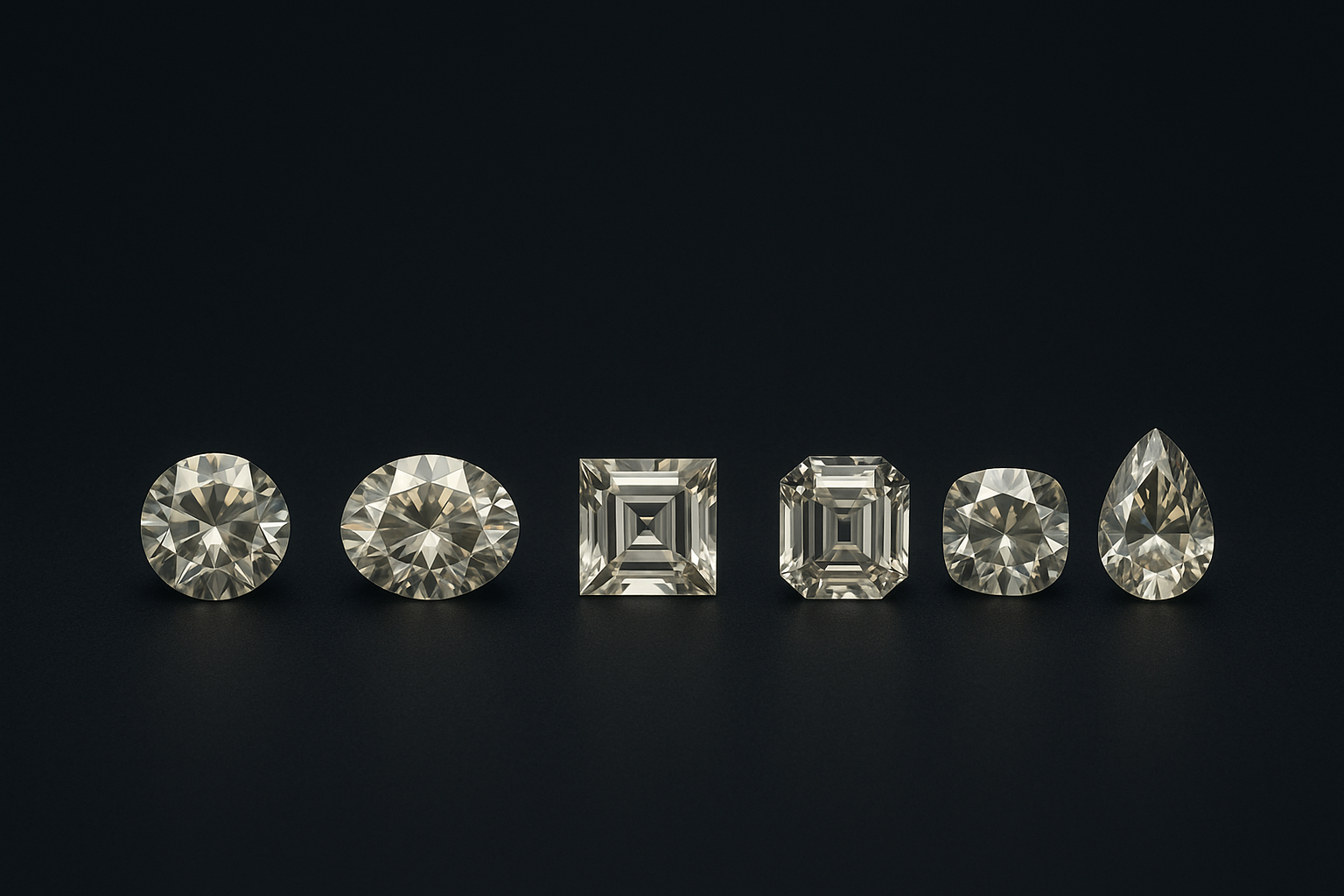
The six common cuts
Round brilliant, oval, princess, emerald (step-cut), cushion, pear. All shown at approximately the same carat weight on a dark museum surface. Per-shape guides in the practical-guides section below.
Buyer-side comparisons
The chapters above cover the structural, regulatory, and economic picture. The guides below apply that picture to specific buyer questions: which carat weight, which shape, which grade, which use case.
Diamond Certifications
GIA, IGI, GCAL, AGS compared. What each laboratory reports on natural and lab-grown, and how to read a certificate.
By CaratPrice by weight (0.5 to 5 carat)
How the lab-grown discount widens with carat. A comparison table across all five weights, linking to each per-carat guide.
By ShapeBy shape (round to fancies)
Five shape guides covering round brilliant, oval, the square family, step cuts, and the pointed fancies.
By GradeG VS1: the most-shopped tier
Why G colour and VS1 clarity together form the most-recommended specification, and how lab-grown and natural compare at this tier.
By UseEngagement rings and beyond
The decision frame for the single largest diamond-purchase category, plus tennis bracelets where the multi-stone maths favours lab-grown.
Vs MaterialLab Diamond vs Moissanite
The cross-category comparison. Why moissanite is not a diamond, the optical and hardness differences, and the FTC naming rules.
AppendixAre lab-grown diamonds worth anything?
The honest resale answer. Why the retail-to-resale gap is wider for lab-grown than natural, and why it appears to be widening further.
AppendixAre natural diamonds losing value?
AWDC Q1 2026 trade data, the De Beers separation signal, and the cyclical-versus-structural split in the current natural-diamond market.
AppendixCVD vs HPHT diamond tester
Why thermal diamond testers cannot distinguish lab-grown from natural, and what equipment actually can: screeners, verifiers, and laboratory PL.
ReferenceThe Bain diamond report
What the Bain Global Diamond Industry Report is, its editions, and the 30%/14% lab-grown price ratios from the 2021-22 edition, still the latest as of 2026.
What we cite, what we exclude, and why
Every numeric and regulatory claim on this site links to a named public source. The pricing figures we report come from three sources only: the Bain Global Diamond Industry Report, AWDC trade-figure press briefings, and De Beers Group public announcements about Lightbox. We do not use retailer price lists, user-submitted price quotes, or Rapaport list prices, because retail prices are promotional and are not directly comparable between vendors.
We do not run affiliate links. We do not rank retailers. The exact-match domain you arrived on is owned by an independent publisher and is monetised, if at all, by display advertising at low density only. The neutrality is the entire ranking argument: this is the reference site, not the funnel.
Common questions
Are lab-grown diamonds real diamonds?
How much cheaper are lab-grown diamonds?
Why did GIA stop grading lab-grown diamonds on the 4Cs scale?
Are lab-grown diamonds better for the environment?
Why does this site not recommend any retailer?
Sources for this chapter
- GIA: 4Cs of Diamond Quality - last verified April 2026
- GIA: Lab-Grown Diamond Reports (Premium / Standard) - last verified April 2026
- FTC: Jewelry Guides, 16 CFR Part 23 (2018 revision) - last verified April 2026
- Bain & Company: A Brilliant Recovery Shapes Up: The Global Diamond Industry 2021-22 (11th annual report) - last verified April 2026
- AWDC: Antwerp Diamond Trade press briefings - last verified April 2026
- De Beers Group: Lightbox Jewelry announcements (2018, 2024, 2025) - last verified April 2026
- IGI: International Gemological Institute - last verified April 2026